Greaton Split Wood Bunkie Boards for Every Bed
Greaton's bunkie boards are built from solid wood, covered in a breathable fabric, and split into four pieces so they actually make it to the bedroom — up narrow stairs, through tight doorways, around hallway corners. At 1.5 inches thick, they sit flat under any mattress without adding meaningful height to your bed. Available in full, queen, and king sizes, they're the straightforward fix for mattresses sinking between slats or frames that don't need a full box spring.

Full, Queen, and King Options
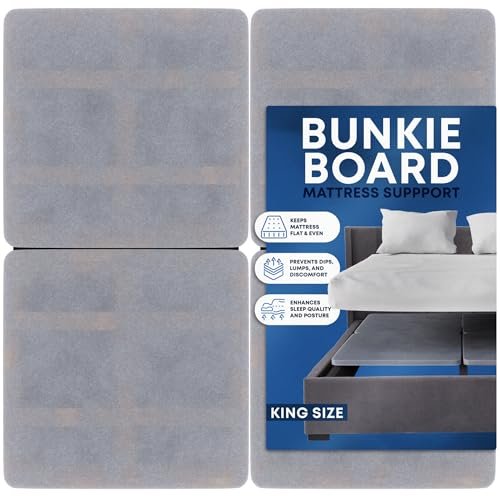
King Bunkie Board Split 4-Piece
See on Amazon
Queen Bunkie Board Split 4-Piece
See on Amazon
Full Bunkie Board Split 4-Piece
See on AmazonBunkie Board Specs by Size
All three boards share the same 1.5-inch profile, solid wood construction, fabric ventilation cover, and 4-piece split format — the only differences are overall dimensions and weight. Use this table to confirm the right size for your frame before ordering.
| Model | Dimensions (L × W × H) | Weight | Pieces | Best For |
|---|---|---|---|---|
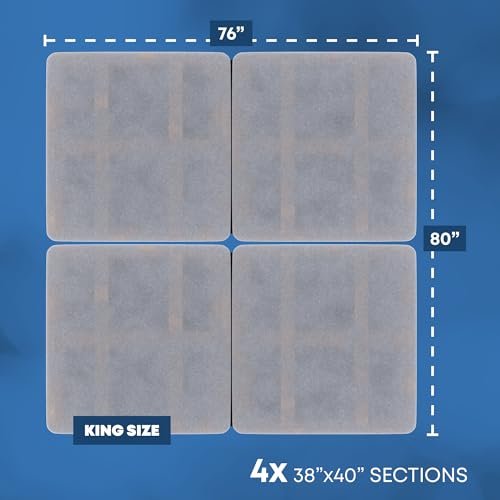
| King Split Wood Bunkie Board | 80" × 76" × 1.5" | 41 lbs | 4 | Standard king frames, platform beds, replacing a king box spring without adding height |
| Queen Split Wood Bunkie Board | 79" × 59" × 1.5" | 32.1 lbs | 4 | Standard queen frames, platform beds, guest rooms, apartments with narrow stairwells |
| Full Split Wood Bunkie Board | 74" × 52" × 1.5" | Not specified | 4 | Full-size frames, bunk beds with full lower bunks, daybeds, smaller bedrooms |
If you're replacing an existing box spring, measure your frame's interior dimensions against the table above — the bunkie board needs to seat inside the frame rails, not on top of them. When in doubt, the queen is the most common fit for standard US queen frames at 79" × 59".
How to Pick the Right Bunkie Board Size
The only thing that matters when choosing between these three boards is getting the dimensions right for your frame. Measure the interior of your bed frame — not the mattress, the frame — before ordering. A half-inch mismatch means the board either shifts around or doesn't seat flat, and either way you'll notice it.
- King (80" × 76" × 1.5", 41 lbs, 4 pieces): Built for standard king frames. At 41 pounds across four pieces, each section is manageable for one person. Confirm your king frame is a standard US king — split king setups with two separate bases need two twin XL boards, not this one.
- Queen (79" × 59" × 1.5", 32 lbs, 4 pieces): Fits standard queen frames. The 79" length and 59" width match a typical queen interior — if your frame runs tight, measure twice. At just over 32 pounds split four ways, this is the easiest of the three to get up a staircase solo.
- Full (74" × 52" × 1.5", 4 pieces): The right call for full-size frames, bunk beds with full-size lower bunks, and daybeds. The 4-piece split design matters here because full-size beds often live in smaller rooms with tighter door clearances than queen or king setups.
All three boards come fully assembled — the four pieces lay flat inside the frame, fit together edge to edge, and the fabric cover holds them in place. There's no hardware, no tools, and no instructions to lose. Open the box, carry the pieces upstairs one at a time, and lay them in the frame before setting the mattress down.
What a Bunkie Board Actually Solves
Most buyers come to a bunkie board from one of two situations: a platform bed frame with slats that are too far apart, causing the mattress to sink and develop soft spots over time, or an older traditional frame where the box spring has finally given up and they don't want to add 8 inches of height to the bed just to replace it. A 1.5-inch bunkie board solves both without asking the mattress to do anything it's not designed to do.
The specific problem with widely spaced slats is that memory foam and latex mattresses — the two types most likely to be used on platform frames — have no internal structure to bridge slat gaps. The foam conforms to whatever's beneath it. Put a foam mattress over slats spaced 4 or 5 inches apart, and within months you'll have ridges and valleys in the sleeping surface that correspond exactly to where the slats are and aren't. A bunkie board closes those gaps entirely, giving the foam a continuous flat surface to work against.
For bunk beds specifically, the bunkie board is the standard solution. Box springs are too tall for most bunk configurations — they either push the top sleeper into the ceiling or prevent the bottom bunk from being usable. A 1.5-inch solid wood board gives a bunk mattress the rigid support it needs without any of the height. The 4-piece split design makes it practical to get the board onto the bunk platform in the first place, which anyone who's tried to maneuver a full-size foundation up a bunk ladder already understands.
Setup, Fit, and Common Mistakes to Avoid
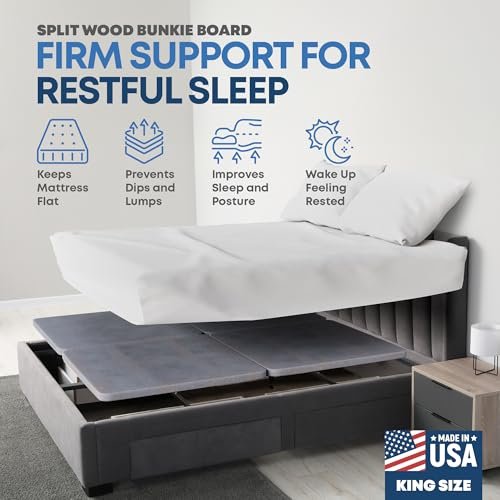
The fabric ventilation cover on all three boards serves two purposes: it keeps the four pieces from sliding around once they're in position, and it allows airflow through the wood rather than trapping moisture between the mattress and the board. Don't remove the cover to "clean the wood" — the fabric is structural, not decorative. If the cover needs spot cleaning, use a damp cloth directly on the fabric.
The most common mistake with bunkie boards is placing them on a frame with a center support rail and not accounting for it. If your bed frame has a center rail running lengthwise down the middle, make sure the bunkie board pieces sit on top of it rather than spanning across it unsupported. The board is solid wood and distributes weight well, but it needs a contact point at center span for a king or queen — most standard frames with a center rail will work fine, but check before you set the mattress down.
- On platform frames: Lay the four pieces in order across the slats, fabric side up. The pieces should sit flush with each other and with the inner lip of the frame. Set the mattress on top — no additional hardware needed.
- On traditional frames with a center rail: Confirm the rail height matches the side rails. A significant height difference between the center rail and side rails will cause the board to bow. On a standard flat frame, this isn't an issue.
- On bunk beds: Carry each piece up separately. The 4-piece split was specifically designed for this — a single full-size foundation is impossible to position on a bunk platform; a quarter of a bunkie board is straightforward.
- Weight distribution: The solid wood construction handles normal sleep loads across all three sizes. Avoid standing or kneeling on a single piece when the board isn't fully supported by the frame beneath it — the wood is load-bearing when lying flat, not when cantilevered off the edge.
Frequently Asked Questions
Will a bunkie board work with a memory foam mattress on a platform bed?
Yes — and this is actually one of the best use cases for it. Platform bed slats are typically spaced 2 to 5 inches apart, and memory foam has no internal structure to bridge those gaps. Over time, the foam sinks into the spaces and develops ridges that correspond to where the slats are. A 1.5-inch solid wood bunkie board lays across those slats and gives the foam a continuous, flat surface to rest on. The fabric ventilation cover allows airflow so moisture doesn't build up between the board and the mattress.
Do the four pieces stay in place, or do they shift around under the mattress?
The fabric ventilation cover wraps all four pieces together and holds them as a unit once they're in position inside the frame. The frame rails keep the board from moving laterally. In normal use — including restless sleepers and people who sit on the edge of the bed — the pieces stay put. If your frame has unusually wide gaps between the side rails and the center support, confirm the board seats fully on the frame before putting the mattress down.
Can I use this on a bunk bed?
Yes, and the 4-piece split design is specifically what makes it practical on a bunk. A traditional bunkie board is one solid piece — getting it onto a bunk platform means lifting and maneuvering an unwieldy panel in a confined space. With the 4-piece format, you carry each section up separately, lay them flat on the bunk platform in order, and the fabric cover holds them together once the mattress is on top. This works for the full-size model on a full bunk and the queen model on a queen bunk.
How is this different from a box spring?
Height is the main difference. A standard box spring adds 8 to 15 inches to your total bed height — enough that a lot of buyers end up with a bed that's genuinely difficult to get in and out of. Greaton's bunkie board adds 1.5 inches. It's also a fundamentally different construction: solid wood with no internal spring or coil system, no metal hardware that can loosen and creak over time. If you're on a platform frame or a bunk bed and don't need the height a box spring provides, the bunkie board is the right call.
Does this require any tools or assembly when it arrives?
No. All three sizes ship fully assembled. Open the box, carry the four pieces to the bedroom, lay them in order inside the frame, and put the mattress on top. There are no tools, no hardware, and no assembly steps. The "4-piece" refers to how the board ships and how you carry it — not to a build-it-yourself kit.
What's the difference between the king and queen bunkie boards beyond size?
Construction and format are identical across all three sizes — solid wood, 1.5-inch profile, fabric ventilation cover, 4 pieces, no assembly required. The king board is 80" × 76" and weighs 41 pounds; the queen is 79" × 59" and weighs 32 pounds. The full board is 74" × 52". Pick based on your frame's interior dimensions — measure the frame, not the mattress, since frame interiors vary by manufacturer even within a nominal size.